Somewhere far beyond Pluto, a big icy world has been quietly circling the Sun for billions of years. Telescopes actually caught it on film as far back as 1937. Nobody noticed. It took a brand-new observatory, a clever piece of search software and one astronomer’s late-night hunch to finally say: wait, what is that?
Its name, for now, is 2026 ED138. And if astronomers confirm what they suspect, it could become only the sixth recognized dwarf planet in our Solar System, joining Pluto, Ceres, Eris, Haumea and Makemake.
A New Telescope’s First Big Surprise
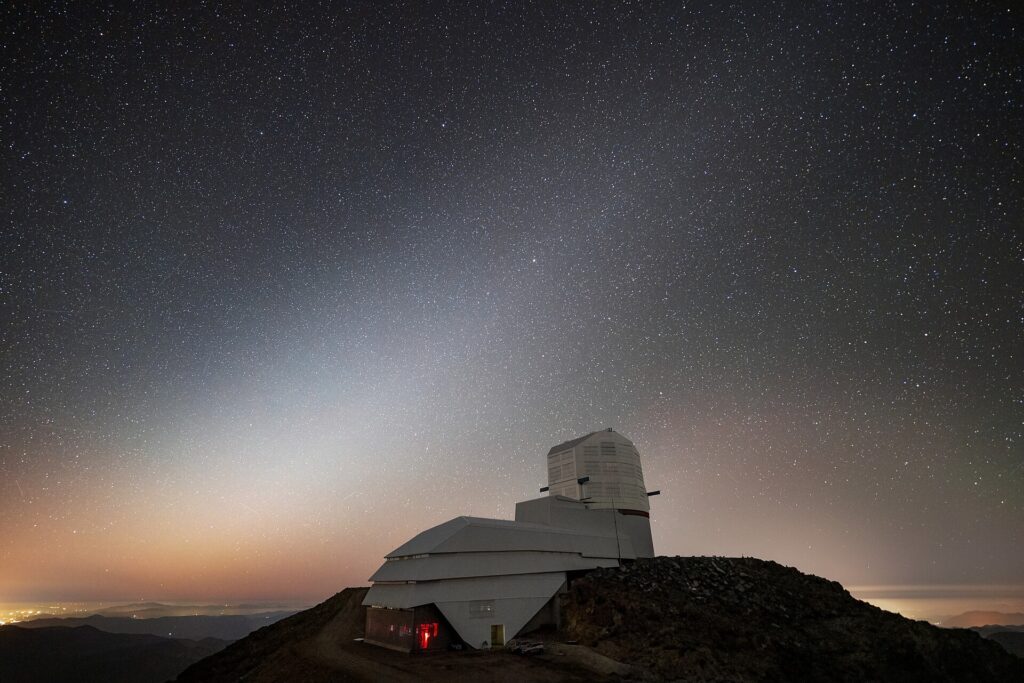
The discovery comes from the NSF–DOE Vera C. Rubin Observatory, a giant new telescope on a mountaintop in Chile built to photograph the entire southern sky over and over for ten years. It carries the largest digital camera ever built, and its main survey, the Legacy Survey of Space and Time (LSST), only officially began in June 2026.
Yet even before that survey started, Rubin was already collecting data. According to the Rubin Observatory’s announcement on October 27, 2026, it was in those early images that the new object turned up. The International Astronomical Union’s Minor Planet Center made the discovery official the same day, and the team presented it at a planetary science meeting in Spokane, Washington.
“Excited Disbelief”
On the evening of October 13, 2026, astronomer Matthew Holman of the Center for Astrophysics | Harvard & Smithsonian was running Rubin data through search code he built with his colleague Kevin Napier. The program compares billions of detections of moving objects and figures out which dots of light belong to the same object as it drifts across the sky.
One of those objects stood out right away. Its brightness and distance meant it had to be unusually big.
“My first reaction was one of excited disbelief. Objects like this are very rare, so I immediately started checking whether I or the code had done something wrong.”
— Matthew Holman, via Rubin Observatory
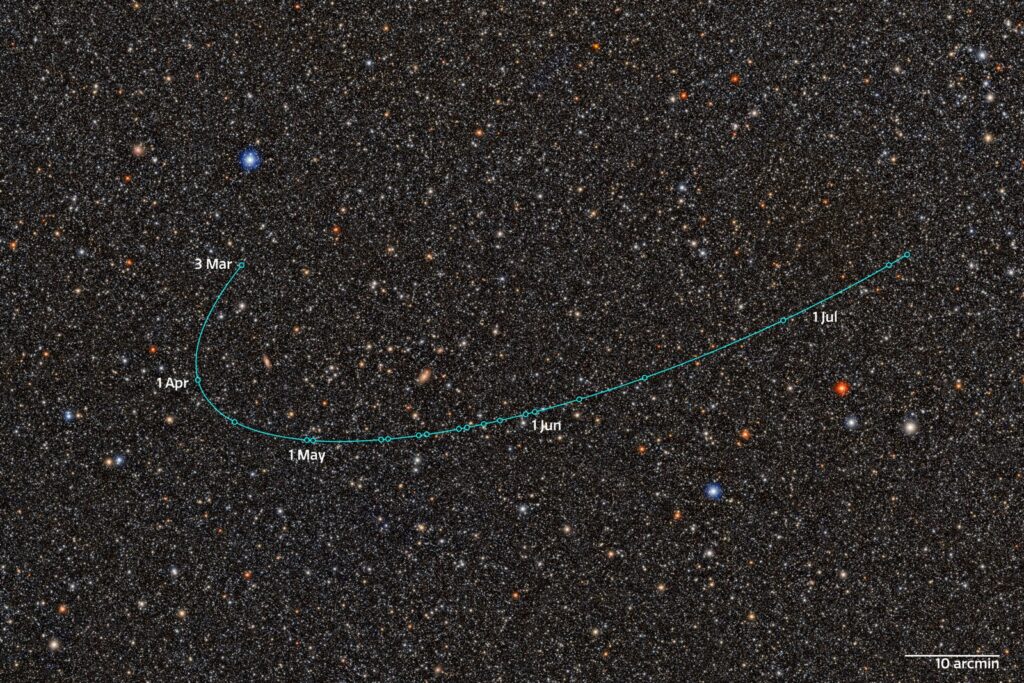
He hadn’t. Rubin’s Solar System lead scientist Mario Jurić of the University of Washington combed back through the observatory’s catalogs and images and found more sightings. In total, Rubin had photographed the object 30 times on 20 different nights between March 4 and July 11, 2026.

Hiding in Plain Sight for Decades
Here’s the part that makes this story so fun: ED138 wasn’t new to the sky. It was just very good at hiding.
The object sits in a part of the sky close to the plane of the Milky Way, a region packed with millions of stars. To most telescopes, one more faint dot there simply gets lost in the crowd. Earlier sky surveys tended to avoid that crowded area, or covered it only shallowly, according to the Rubin Solar System team’s note on the Rubin community forum.
Once astronomers knew where to look, though, the object started showing up everywhere:
- Dark Energy Camera images back to 2016, found with the Asteroid Institute’s precovery service, gave the team more than ten years of orbit to work with.
- Old photographic plates from 1954 to 2000, twelve of them, also captured it, according to a follow-up study posted on November 2, 2026 (not yet peer reviewed).
- A faint trace on a 1937 Harvard glass plate is listed in that same study as a “marginal detection,” which would stretch the record back 89 years.
Think about that for a second. People were photographing this little world before World War II, and it took until 2026 for anyone to realize it was there.
“Once we identify a new object, we can search back months, and sometimes even decades, finding it in images where nobody knew to look.”
— Mario Jurić, via Rubin Observatory
How Big Is It, and Where Is It?
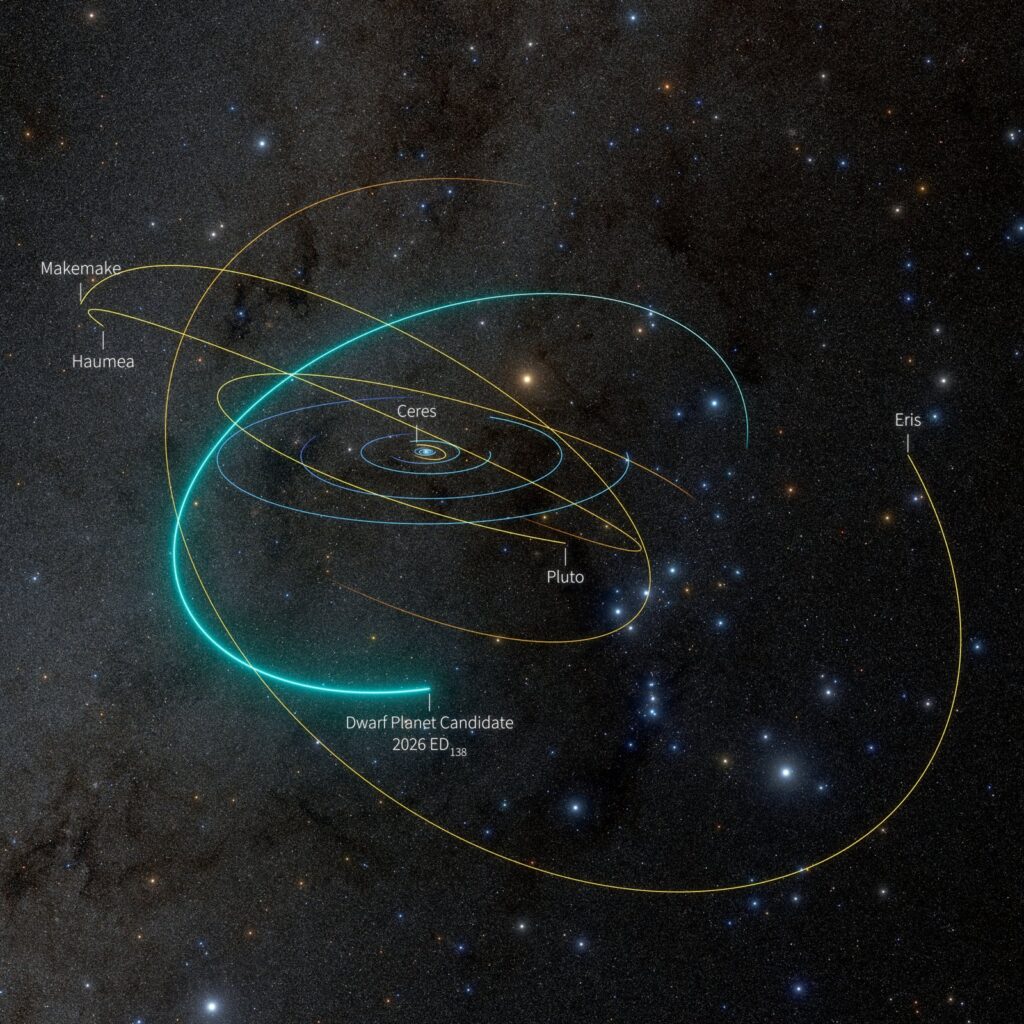
Right now, ED138 is about 46 astronomical units from the Sun. One astronomical unit is the average distance between Earth and the Sun, so that’s 46 times farther out than we are. For comparison, Pluto’s average distance is about 40.
That makes ED138 a trans-Neptunian object, one of the icy bodies that orbit beyond Neptune. Its orbit is also tilted almost 25 degrees compared to the plane where the main planets travel, which suggests Neptune’s gravity knocked it off its original path long ago. According to Smithsonian Magazine, one trip around the Sun takes it roughly 281 years.
As for size, the team estimates it is somewhere between 600 and 1,500 kilometers across (roughly 370 to 930 miles). That’s a wide range, and there’s a good reason for it. Astronomers can measure how bright the object looks, but they don’t yet know how reflective its surface is. A dark surface would mean a bigger body; a shiny, icy surface would mean a smaller one.
The Rubin team says it is still one of the intrinsically brightest objects found beyond Neptune in more than a decade, and icy bodies that large are expected to be pulled into a round shape by their own gravity. Being round is one of the key requirements for dwarf planet status.
So Is It Officially a Dwarf Planet?
Not yet, and the scientists are careful to say so. For now it’s a dwarf planet candidate. To confirm it, astronomers need infrared observations that can pin down its real size.
There’s another exciting way to measure it, too. The follow-up study predicts 15 stellar occultations between 2027 and 2030, moments when ED138 will pass in front of a background star and briefly block its light. Six of those are expected to happen over populated land. When an object blocks a star, observers at different locations can time the blink and work out the object’s size and shape very precisely. Events like this often bring amateur and professional astronomers together, so ED138 could become a fun target for skywatchers in the next few years.
Why This Is Only the Beginning
The most exciting thing about ED138 may not be the object itself. It’s what it says about the telescope that found it.
Back in April 2026, before the main survey even started, the Rubin Solar System team had already submitted observations of more than 11,000 new asteroids to the Minor Planet Center, including roughly 380 new trans-Neptunian objects. They called it “the tip of the iceberg.” Now, with its first dwarf planet candidate, that prediction is starting to come true.
“Rubin will image the whole southern sky again and again for ten years, so any others hiding in the places earlier surveys skipped are now within reach.”
— Matthew Holman, via Rubin Observatory
Want to see it for yourself? The public can explore ED138’s orbit in 3D on Rubin’s free Orbitviewer app.
Why It’s Worth Celebrating
We tend to think of our Solar System as a place we already know well. Eight planets, a handful of dwarf planets, done. Stories like this are a lovely reminder that it’s still full of surprises, some of them hiding in old photographs that have been sitting in archives for nearly a century.
Somewhere out past Pluto, a world possibly hundreds of kilometers wide has been making its slow, 281-year loop around the Sun all along. Thanks to a new telescope and a scientist who double-checked his own excitement, we finally know it’s there.
Sources
- Rubin Observatory: NSF–DOE Vera C. Rubin Observatory Reveals Its First Dwarf Planet Candidate in Our Solar System (October 27, 2026)
- Rubin Community Forum: 2026 ED138, a dwarf-planet candidate found in early Rubin data (Mario Jurić and Matthew Holman)
- arXiv:2611.02371: A Century-Long Archival Search and Analysis of the Rubin Observatory-Discovered Dwarf Planet Candidate 2026 ED138 (preprint, November 2, 2026)
- Smithsonian Magazine: Astronomers Found a Mysterious Object Orbiting Far Beyond Pluto (November 2026)
Image Credits
- Rubin Observatory under zodiacal light: Hernán Stockebrand / Rubin Observatory / NOIRLab via Wikimedia Commons, CC BY 4.0
- Discovery mosaic: NSF–DOE Vera C. Rubin Observatory/NOIRLab/SLAC/AURA, CC BY 4.0
- Orbital arc: NSF–DOE Vera C. Rubin Observatory/NOIRLab/SLAC/AURA, CC BY 4.0
- Orbit with dwarf planets: NSF–DOE Vera C. Rubin Observatory/NOIRLab/SLAC/AURA/R. Proctor, CC BY 4.0