Some upgrades happen with the tap of a button. This one took more than five years, eight giant solar arrays, and a lot of careful work by astronauts floating 250-plus miles above Earth.
On November 5, 2026, NASA astronaut Anil Menon and Canadian Space Agency astronaut Joshua Kutryk stepped outside the International Space Station and installed the eighth and final roll-out solar array. With it, the station’s long-running power upgrade is officially complete, according to NASA’s space station blog.
The result: the station’s power generation capacity rises from 160 kilowatts to about 215 kilowatts — a boost of up to 30%. And the clever part is how those new panels work. They don’t unfold like a map. They unroll, all by themselves, like a tape measure.
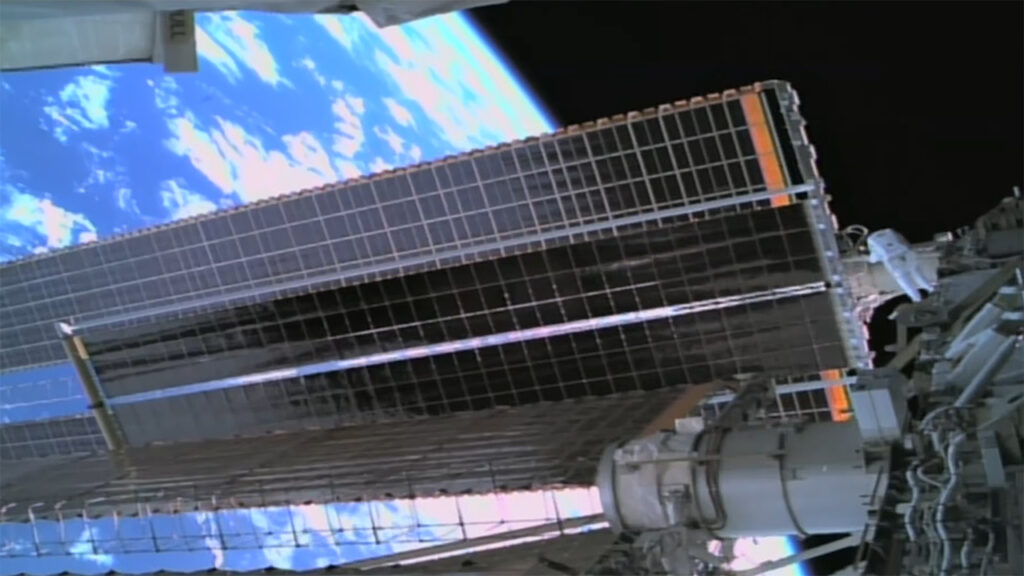
Two spacewalks, one week, one finished job
Menon and Kutryk actually did this twice in eight days.
On October 29, they spent 7 hours and 11 minutes outside to install the seventh array on the station’s port (left) side. That outing was also a milestone of its own: NASA counted it as U.S. spacewalk 100. It was Menon’s fourth spacewalk and Kutryk’s very first. NASA said that array will provide extra power for critical operations — including, eventually, a safe and controlled deorbit of the station at the end of its life (NASA).
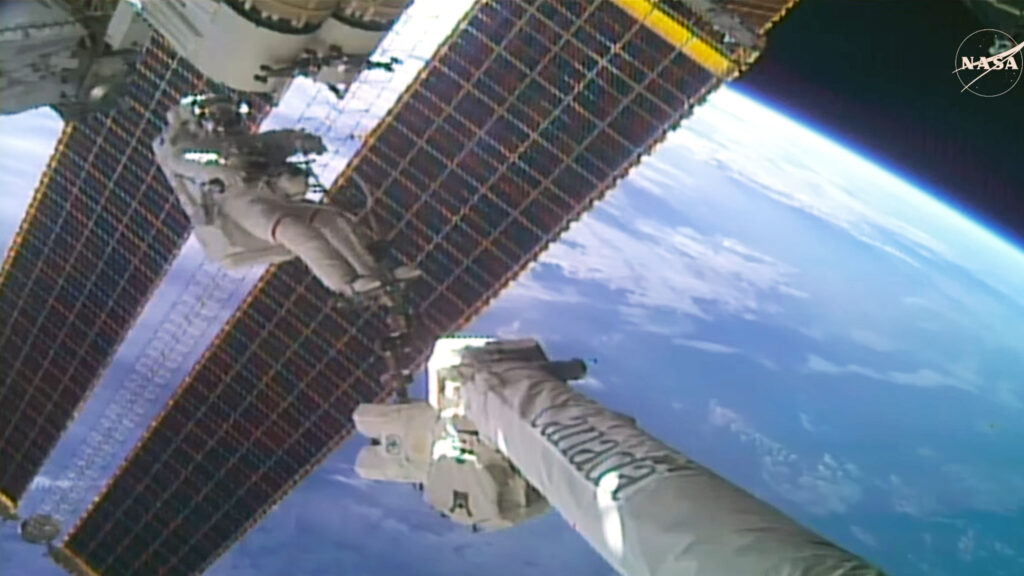
Then on November 5, they went back out — this time to the far end of the starboard (right) side — and repeated the job. The spacewalk began at 8:36 a.m. EST and wrapped up at 3:35 p.m. EST, lasting 6 hours and 59 minutes.
NASA’s preview described a choreography that sounds almost like a relay race in slow motion. Menon, attached to the end of the station’s Canadarm2 robotic arm, carried the rolled-up array out to the work area. He handed it to Kutryk, detached from the arm, and moved to the installation site, where Kutryk handed it back so the two could finish the job together. Inside, NASA flight engineers Jessica Watkins and Luke Delaney had studied the robotic arm moves needed to support them (NASA).
It was U.S. spacewalk 101 — Menon’s fifth and Kutryk’s second — and the 286th spacewalk in support of space station assembly, maintenance, and upgrades.
Why the space station needed new solar power
The station’s original solar wings are huge and have served remarkably well. The first pair was deployed back in December 2000. But they were designed for a 15-year service life, and by 2021 NASA said they were showing the expected signs of wear after operating well beyond that (NASA, 2021).
Rather than rip the old arrays off, NASA chose a smarter path: place newer, more efficient arrays in front of the old ones, on the same mounting points. Each new array shades a little more than half of the original wing behind it, so both old and new keep producing power together.
The new arrays are about half the size of the legacy wings — roughly 60 feet long and 20 feet wide (about 18 by 6 meters) — but they punch well above their weight. NASA’s engineering team noted their high-efficiency solar cells convert sunlight more than twice as well at the start of their lives as the old ones did: 30.7% versus 14.2% (NASA APPEL).
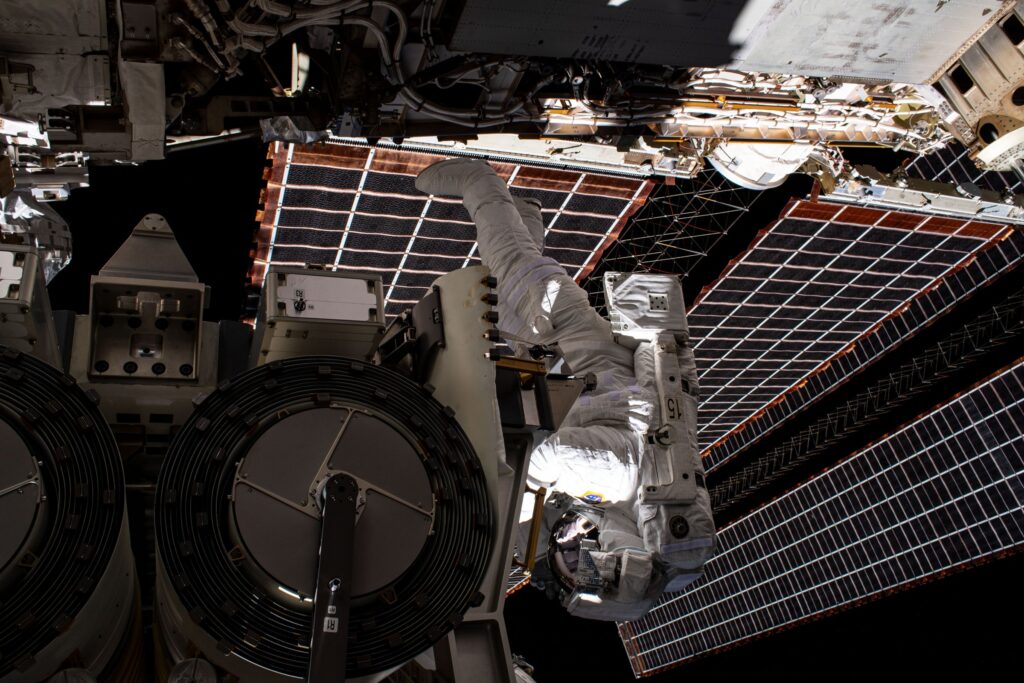
The magic trick: solar panels that unroll themselves
Here is the genuinely cool part. These arrays are called IROSAs — International Space Station Roll-Out Solar Arrays — and they have no motors to deploy them.
For launch, the solar “blanket” is rolled up into a compact cylinder, like a yoga mat. Along its edges run carbon fiber booms that are flattened and rolled up against their natural shape. That stores energy in the material, the same way a tape measure “wants” to snap straight.
Once astronauts bolt an array into place, a couple of bolts are removed, and that stored energy gently unrolls the whole thing. When the first one deployed in 2021, the unrolling took about six minutes. As the booms straighten, they become stiff support beams that hold the array in shape.
The idea was tested on the station itself first. In June 2017, a smaller Roll-Out Solar Array experiment was unrolled from the tip of Canadarm2 to see how the design behaved in real space conditions. It worked, and the technology was later adapted to power the station.
The same roll-out design has traveled farther, too: NASA’s DART spacecraft flew with roll-out solar arrays on its way to crash into the asteroid moonlet Dimorphos — the same space rock that ESA’s Hera mission recently caught sight of for the first time.
From a clean room in Florida to the end of the truss
The IROSAs were designed, built, and tested by Redwire under a contract with Boeing, NASA’s prime contractor for station operations. Six arrays were installed between 2021 and 2023, starting with a pair put in place by NASA astronaut Shane Kimbrough and ESA astronaut Thomas Pesquet in June 2021.
In 2023, power projections led NASA to request one more set. Those final two arrays launched in the trunk of a SpaceX Dragon on the company’s 35th commercial resupply mission (NASA).
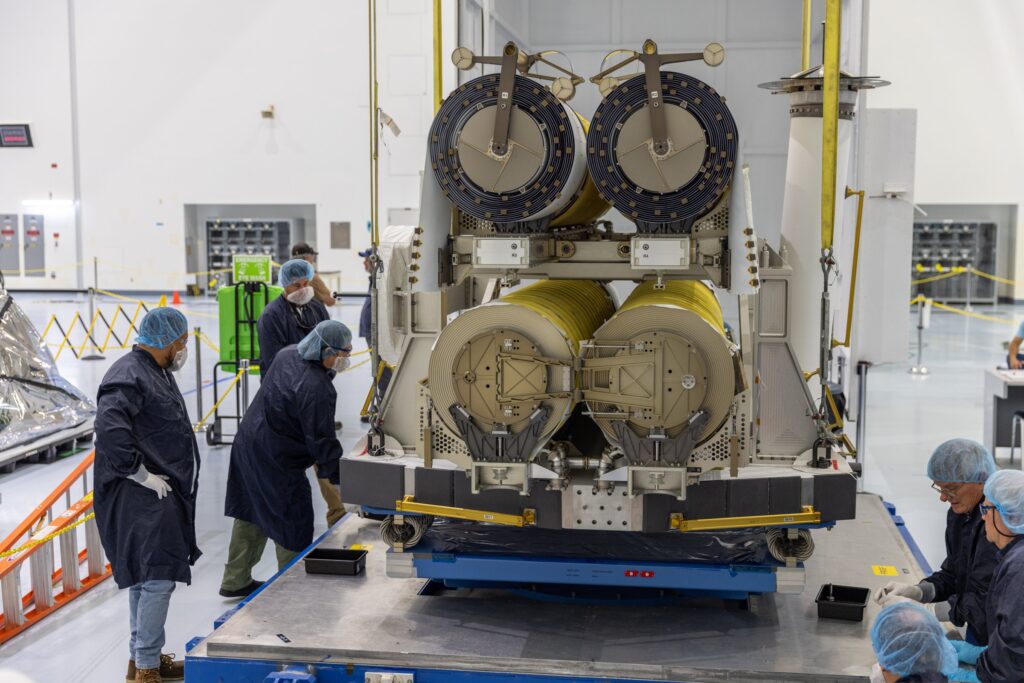
Look closely at that photo from Kennedy Space Center: those big rolls are the arrays, packed tight before their trip to orbit. A few months later, they were stretched out in sunlight on opposite ends of the station.
Counting all the preparation work, NASA says astronauts completed 18 spacewalks since the power upgrade effort began in February 2021 to get the power channels ready and install all eight arrays.
Why this is worth celebrating
Electricity is everything on the space station. NASA notes that solar power keeps life support running, supports the crew’s daily activities, and powers hundreds of research investigations — from biology to new technology for future deep-space missions.
Even the week of the final spacewalk was busy with science. While Menon and Kutryk prepared, the crew was checking station water samples for microbes, swabbing surfaces, collecting bacteria samples to test for antibiotic resistance, and growing human lung cells in microgravity. All of that runs on sunlight.
So the next time you see the station gliding overhead as a bright, steady dot, picture it with eight new solar “yoga mats” rolled out across its wings — installed by hand, one careful spacewalk at a time.
Quick facts
- Final array installed: November 5, 2026, starboard truss (3B power channel)
- Spacewalkers: Anil Menon (NASA) and Joshua Kutryk (CSA)
- Power capacity: from 160 kW to about 215 kW (up to 30% more)
- Arrays installed: eight IROSAs, 2021–2026
- Spacewalks for the upgrade: 18
- How they deploy: stored energy in rolled carbon fiber booms — no motors
Sources
- NASA: Spacewalkers Install Final Roll-Out Solar Array (Nov. 5, 2026)
- NASA: Astronauts are Go for Final Power Upgrade Spacewalk (Nov. 4, 2026)
- NASA: Spacewalkers Install Roll-Out Solar Array for Power Generation (Oct. 29, 2026)
- NASA: Power Up — Roll Out Solar Arrays Boost Space Station Power Supply (Oct. 15, 2026)
- NASA: Spacewalkers Successfully Deploy Solar Arrays (June 2021)
- NASA APPEL: Astronauts Continue Space Station Power Upgrades (June 2021)
Image credits: NASA (public domain). Kennedy Space Center photo by NASA/Clayton Rougelot and 2021 spacewalk photo by NASA/Thomas Pesquet, both via Wikimedia Commons (public domain).