November 23, 2026
For most of human history, the oceanic whitetip shark was one of the most common large animals in the open ocean. Sailors called it the “messenger of the deep,” and Pacific islanders read its appearance as a sign of approaching storms. Today it is one of the most endangered. At a global wildlife summit late last year, the world finally moved to stop that slide.
At the 20th Conference of the Parties to CITES — the treaty that regulates international wildlife trade — held in Uzbekistan, governments voted by overwhelming consensus to uplist the oceanic whitetip shark to Appendix I, the highest level of protection the convention offers. It is the first shark species ever to receive that listing, which means commercial international trade in the species is now banned.
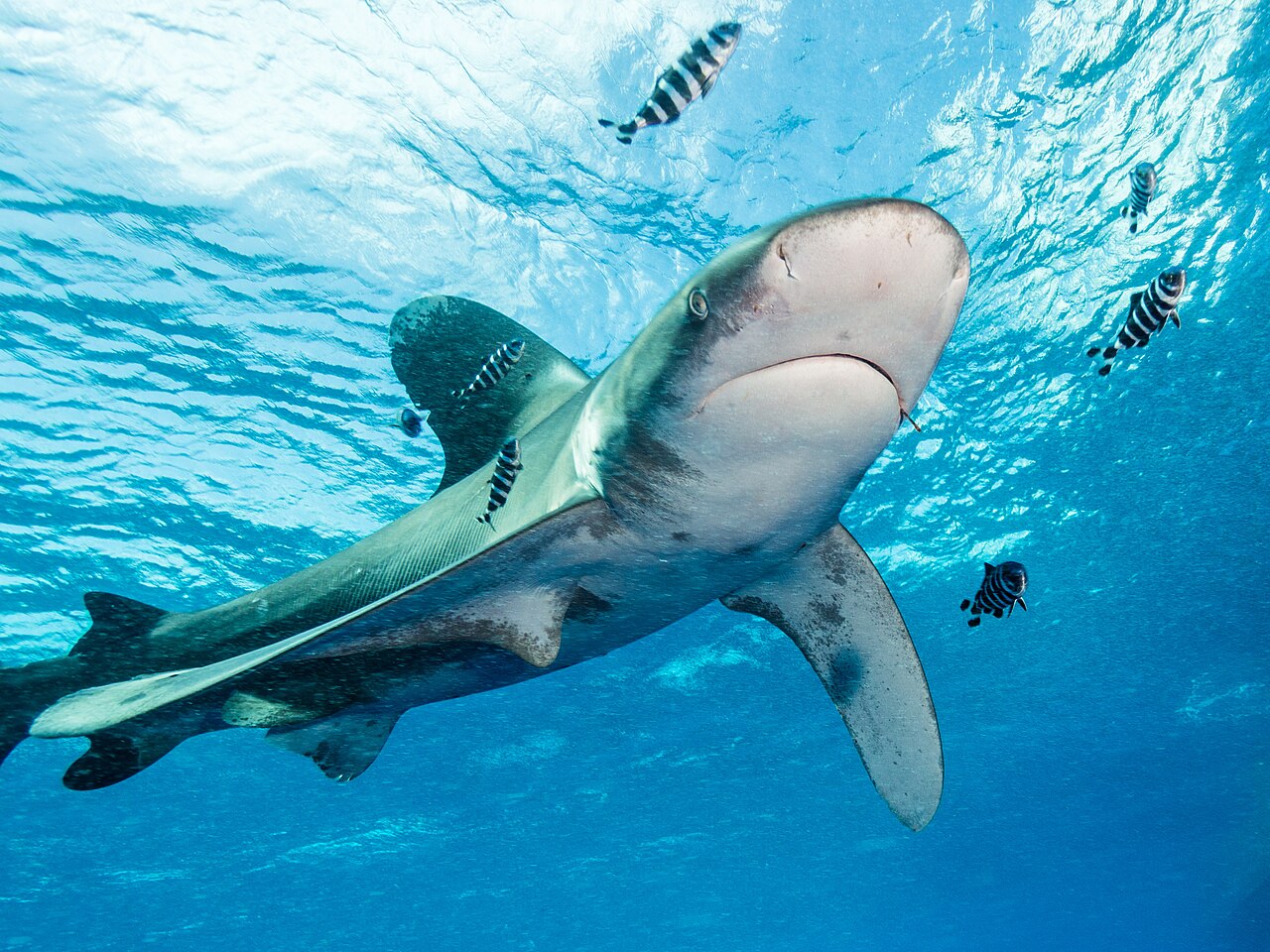
A shark that ruled the open ocean
The oceanic whitetip (Carcharhinus longimanus) is built for the open sea. It has a stocky body, long, rounded pectoral fins and a tall, white-tipped dorsal fin that cuts the surface like a sail. Unlike reef sharks that stick to coral, whitetips roam the deep blue, far from land, where they have few natural enemies.
That freedom once made them extraordinarily successful. But it also put them in the path of industrial fishing. Longlines and nets set for tuna and swordfish catch whitetips as bycatch, and their large fins are prized for shark fin soup. The combination has been devastating.
From abundant to critically endangered
The numbers tell the story plainly. Oceanic whitetips have declined by roughly 95% in some regions, and the species is now listed as Critically Endangered on the IUCN Red List. More than one-third of all shark and ray species are now threatened with extinction, and for species caught for the fin trade, the picture is even worse: over 70% of them meet IUCN thresholds for Vulnerable, Endangered or Critically Endangered status.
The fin trade numbers are staggering. DNA testing on more than 16,000 fins in Hong Kong — the world’s largest shark fin market — found the oceanic whitetip appearing 70 times more often than governments had reported. In just three years, traders moved fins from over 36,000 illegally caught oceanic whitetips. Trade rules simply had not kept up with the killing.
What Appendix I actually does
CITES Appendix I is not a suggestion. It is a commercial ban: no international trade in the species or its parts is permitted, with only narrow exceptions for scientific or conservation purposes. For the oceanic whitetip, that means its fins can no longer move legally across borders at all.
The listing also removes ambiguity. Before, enforcement officers had to navigate a maze of permits and quotas; now the rule is simple — if it is in the market, it should not be. That bright line is what makes Appendix I the strongest tool countries have to choke off the illegal fin flow.
Why this is a real turning point
This is not symbolic. The same approach has worked before. When green sea turtles were banned from commercial trade in the 1980s, the global trade collapsed and populations rebounded so strongly that the species is now listed as “Least Concern.” For the oceanic whitetip, the Appendix I listing could be the difference between recovery and disappearance over the coming decades.
The vote also set the tone for the rest of the conference. It paved the way for further Appendix I listings at the same meeting, including whale sharks and manta and devil rays — meaning international commercial trade is now banned for all of them.
Panama sets the pace
The listing was led by Panama, which has become an unlikely ocean champion. Panama now protects 54% of its national waters, well beyond the global target of protecting 30% of the ocean by 2030, and it was among the first countries to join the 100% Alliance, pledging to sustainably manage all of its ocean area. It has also stepped up monitoring and enforcement against illegal fishing in its Pacific waters.
Panama will also host the next CITES Conference of the Parties, likely in 2028, where it will help keep global momentum going for threatened species.
What comes next
A listing on paper is only the beginning. Enforcement has to follow — in ports, markets and supply chains across dozens of countries. As conservationists note, the critical next steps include scaling up species protection, closing enforcement gaps and monitoring whether populations actually begin to recover.
But for a shark that was once written off as doomed, the world has finally stopped managing its decline and started planning its recovery. That is good news worth sharing.
Sources
- Cristina Mittermeier and Luke Warwick, “Good News About Sharks,” TIME, February 2, 2026.
- CITES, “Oceanic whitetip shark uplisted to Appendix I,” CoP20, 2025.
- IUCN SSC Shark Specialist Group, 2024–2025 report.
- Wildlife Conservation Society, shark and ray conservation program.
Image credits
- Oceanic whitetip shark photo: Alexander Vasenin, CC BY-SA 4.0, via Wikimedia Commons. (Stock photo; not from the CITES meeting.)