Imagine arriving at a fireworks show after the last rocket has burst. The sky is quiet, but the drifting smoke still holds clues: how many fireworks went off, how big they were and which way they flew. Astronomers have just done the cosmic version of that detective work, and the result is a little mind-bending. By reading the dust left behind by an exploded star, they think they can see what was happening deep inside it in the final hours before it died.
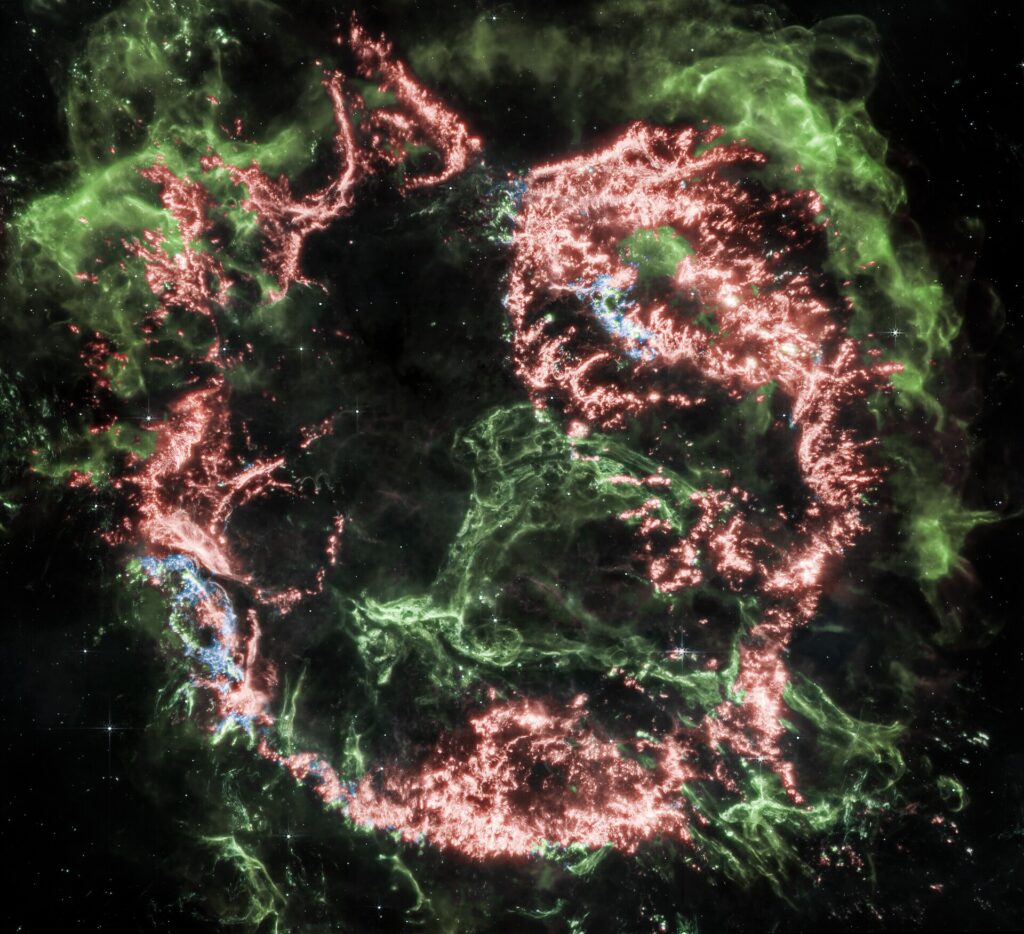
The star in question created Cassiopeia A, one of the most famous supernova remnants in the sky. On November 23, 2026, NASA and the European Space Agency released a gorgeous new image of it from the James Webb Space Telescope, along with a study in The Astrophysical Journal Letters that points to a dramatic last-minute shake-up inside the star.
Meet Cassiopeia A, a star turned inside out
Cassiopeia A, or Cas A for short, sits about 11,000 light-years away in the constellation Cassiopeia. Light from the explosion is thought to have reached Earth in the second half of the 1600s, which makes it one of the youngest supernova remnants in our galaxy. Today it is an expanding cloud of gas and dust roughly 10 light-years across, and according to Purdue University astronomer Danny Milisavljevic, its debris is still racing outward at about 5,000 kilometers per second, fast enough that changes show up in images taken just a couple of years apart.
That makes Cas A a favorite laboratory. Scientists can’t look inside a living star, so a remnant like this is the next best thing: the star has, in effect, turned itself inside out and spread its contents across space for us to study.
Why a star’s layers matter
Massive stars are built a bit like onions. As they age, they fuse hydrogen into helium, then helium into heavier elements, and so on, with the heaviest elements forming in the core (the process stops at iron) and lighter elements burning in shells around it. Each layer is a record of the star’s life story.
When the star explodes, those elements are flung into space. As the hot gas cools, some of it condenses into dust: tiny solid grains far smaller than the width of a human hair. Because different layers make different kinds of dust, the dust works like a fingerprint of where it came from.
An old telescope showed a new one where to look
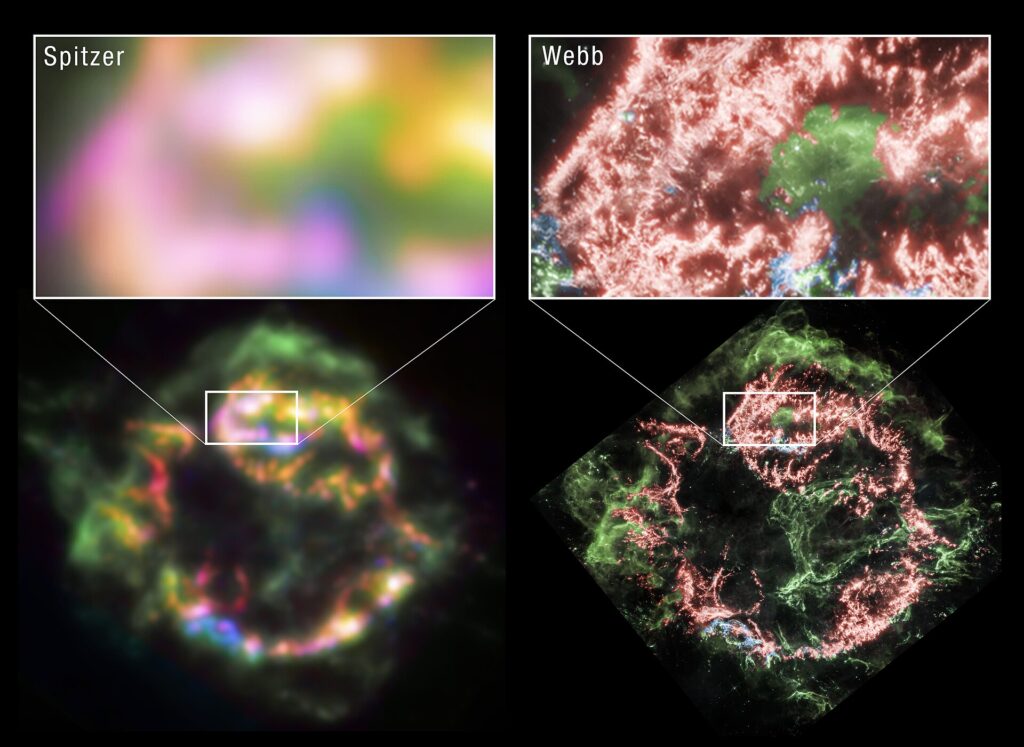
This discovery is also a nice story of teamwork across generations of telescopes. NASA’s Spitzer Space Telescope, retired in 2020, couldn’t make out fine details in Cas A, but it flagged three regions where the dust looked different. The team, led by Columbia University astronomer Tea Temim, then pointed Webb’s Mid-Infrared Instrument at those spots.
Webb is sharp enough to pick out individual clumps of debris, each roughly the size of our solar system, and analyze their light one by one. Here is what it found:
- Region one: debris hit by Cas A’s “reverse shock” (a shock wave moving back inward into the explosion’s debris), made mostly of silica dust.
- Region two: more reverse-shocked debris, this time dominated by carbon dust.
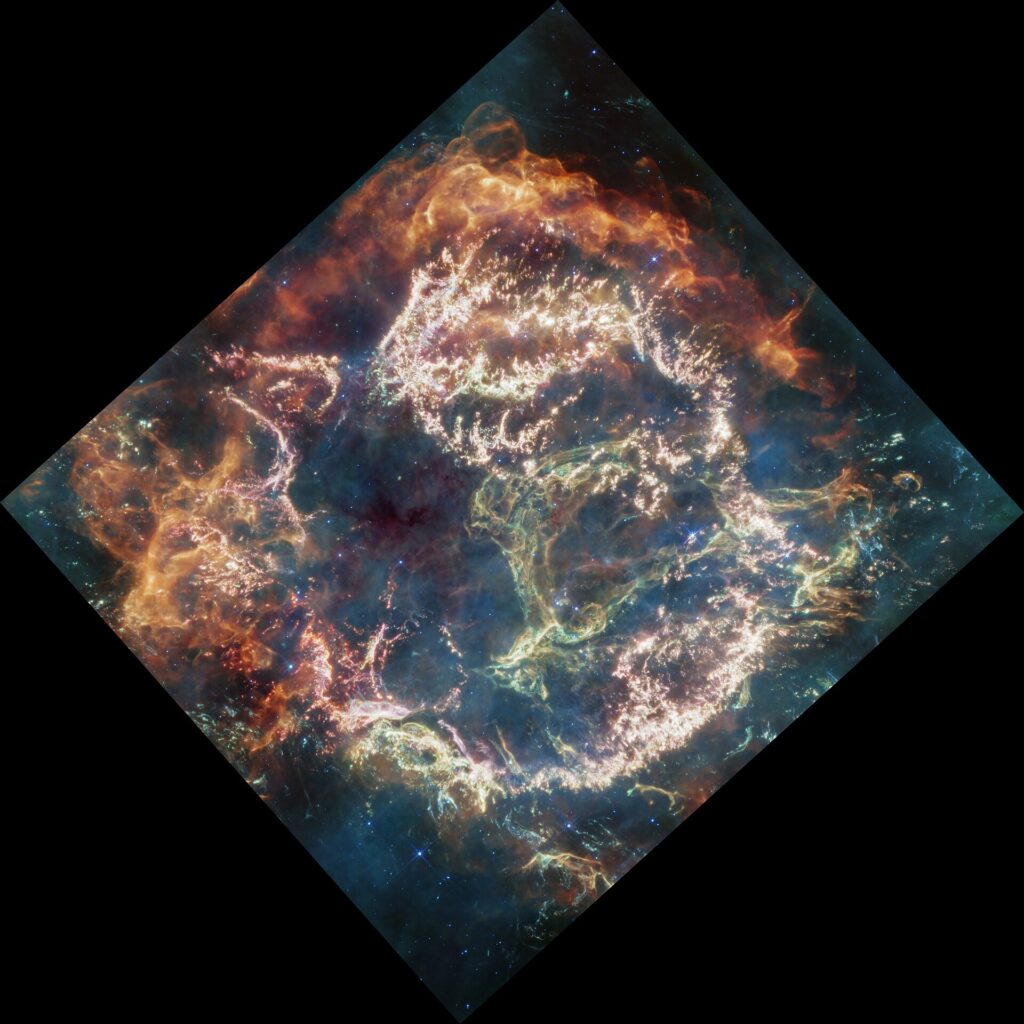
- Region three: the “Green Monster,” a structure Webb itself discovered in 2023, rich in magnesium silicates. Unlike the other two, it is made of material the star shed before it exploded, not debris from the blast.
The surprise: a shake-up just before the end
The dust chemistry didn’t match a star whose layers stayed neatly stacked until the very end. Instead, it supports a scenario called a shell merger, in which neighboring burning layers churn, mix and merge shortly before the star collapses.
Material within these shells churns and circulates, which can cause the shells to merge shortly before the supernova explosion. So, for example, the oxygen- and carbon-burning shells in a star merge together and change the structure of the star significantly.
Tea Temim, lead author, Columbia University (via NASA)
Webb then mapped dust across the whole remnant and found merger signatures in much of it. Combined with X-ray observations from NASA’s Chandra X-ray Observatory and the Japanese-led XRISM satellite, the evidence points to the merger being underway very shortly before the explosion, possibly just hours before.
What’s amazing is that the dust, which we are testing hundreds of years after the explosion, tells us about what’s happened to the star potentially only hours before it exploded.
Danny Milisavljevic, Purdue University
Why this is good news for all of us
This might sound like distant, abstract physics, but it is really part of our own origin story. The oxygen we breathe, the silicon in rocks and the iron in our blood were forged inside stars and scattered by explosions like this one. As Milisavljevic put it, “By understanding the process of exploding stars, we are reading our own origin story.”
A few reasons the result matters:
- A new tool: the team says resolved dust maps can now be used to work out the inner structure of other exploded stars, too.
- Better recipes for planets: knowing which elements a supernova releases, and in what form, helps explain how future stars and planets are built.
- Dust survival: co-author Ilse De Looze of Ghent University notes the findings help show how well newly made dust survives the shocks rattling through the debris, which decides how much ends up seeding our galaxy.
The bottom line
More than three centuries after its light first reached Earth, the star behind Cassiopeia A is still telling its story. Thanks to a retired telescope that knew where to look and a new one sharp enough to read the clues, astronomers could watch, in a sense, the last frantic hours of a star’s life, written in dust.
Sources
- NASA Science: NASA’s Webb Shows How Supernova Dust Chronicles Star Evolution (Nov 23, 2026)
- ESA/Webb science release weic2624 (Nov 23, 2026)
- Purdue University: New space telescope data decodes death throes of stars (Nov 23, 2026)
- Universe Today: Making Sense of Chaotic Supernova Ejecta With the JWST (Nov 23, 2026)
- Temim et al., “JWST Resolves Dust Emission from Individual Ejecta Clumps in Cassiopeia A: Dominant Grain Compositions Point to a Shell Merger in the Progenitor,” The Astrophysical Journal Letters 1012, L26 (2026). DOI: 10.3847/2041-8213/aea901
Image credits
- Cassiopeia A (MIRI image), weic2624a: NASA, ESA, CSA, T. Temim, R. Arendt, D. Milisavljevic; processing J. DePasquale (STScI). CC BY 4.0. Source
- Cassiopeia A (Spitzer and Webb image), weic2624c: NASA, ESA, CSA, JPL-Caltech, T. Temim, R. Arendt, D. Milisavljevic; processing A. Pagan (STScI). CC BY 4.0. Source
- Cassiopeia A (MIRI image, 2023): NASA, ESA, CSA, D. Milisavljevic, T. Temim, I. De Looze; processing J. DePasquale (STScI). Public domain. Source
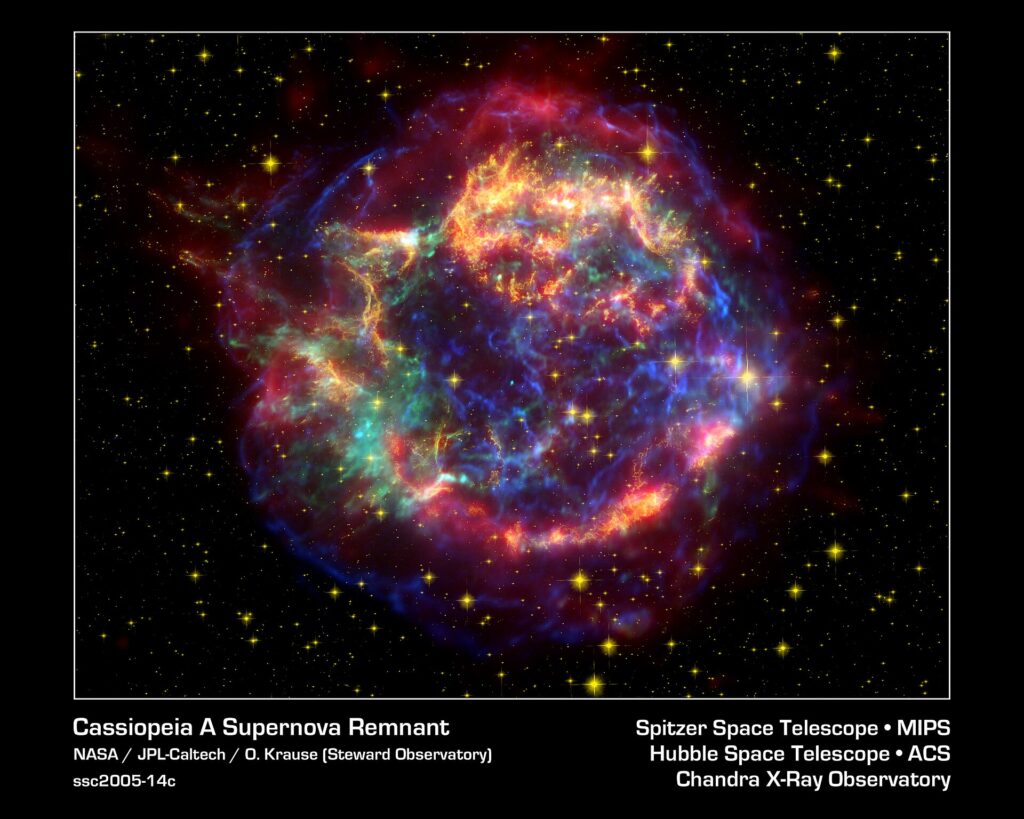
- Cassiopeia A (Spitzer/Hubble/Chandra composite, 2005): NASA/JPL-Caltech/O. Krause (Steward Observatory). Public domain. Source
The 2023 Webb image and the Spitzer/Hubble/Chandra composite are earlier views of Cassiopeia A, included for context; the two 2026 images come from the new release.