For her first days, Hope weighed less than half an ounce. The Spix’s macaw chick hatched at São Paulo Zoo on Oct. 25 at 12.4 grams, after a biologist helped her out of an egg she could not break open on her own. On Nov. 24, the zoo introduced her to the press: the first Spix’s macaw ever hatched in a Brazilian zoo.
It is a small, fragile milestone for one of the rarest birds on Earth. The Spix’s macaw is officially extinct in the wild, and the entire global population — about 330 birds — lives in breeding centers, zoos and private collections. Hope is bird number 28 at São Paulo alone.
The egg that needed a hand
Hope’s hatch was not routine. The chick was malpositioned inside the egg, lined up the wrong way for the shell to break cleanly, and the egg had already reached the end of its incubation window, according to the zoo. Fernanda Guida, who heads the zoo’s bird department, stepped in to help remove her.
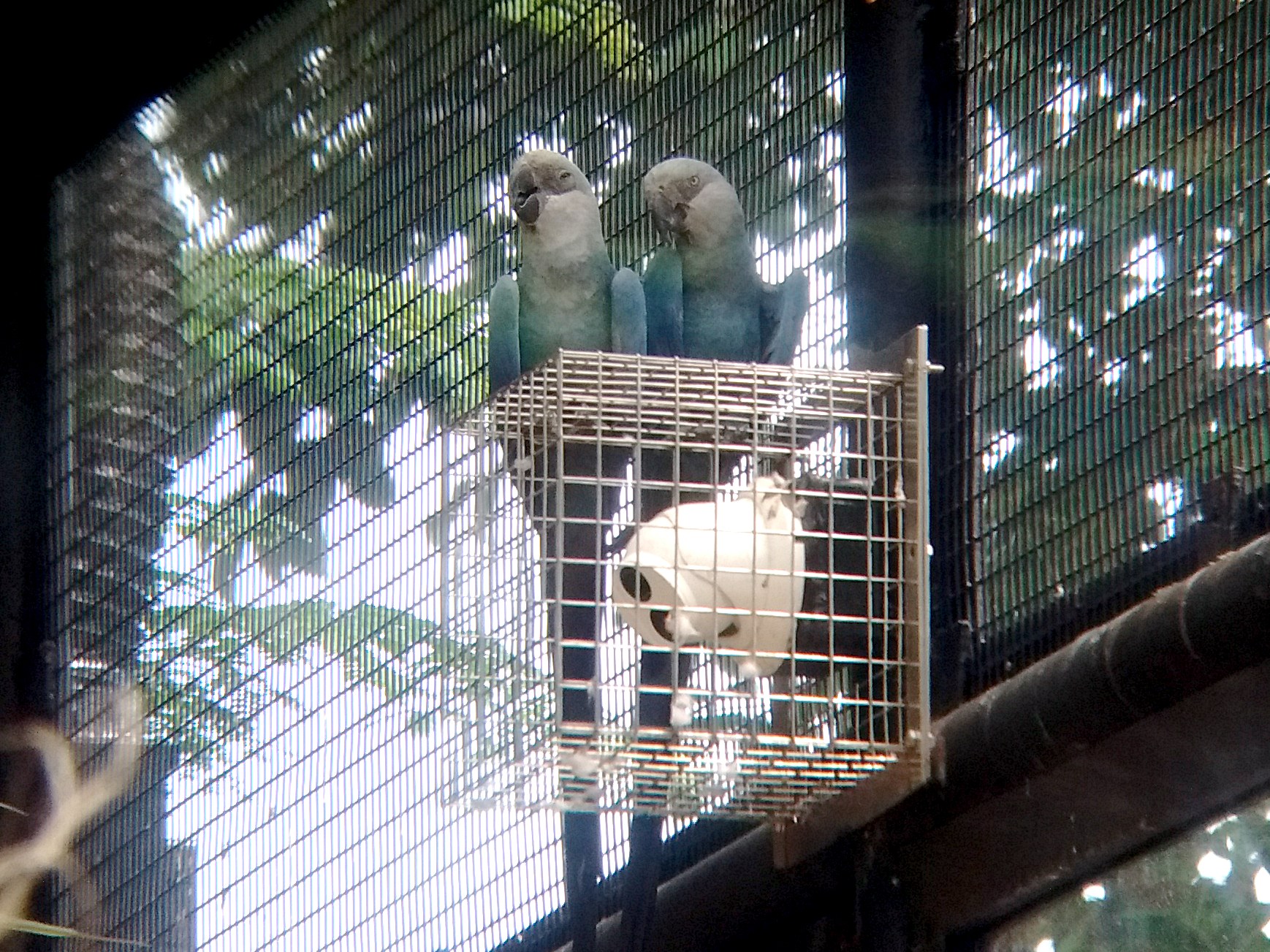
She came out at 12.4 grams. An adult Spix’s macaw weighs about 300 grams and measures roughly 55 centimetres from beak to tail, with a grey-blue head, pale blue underparts and a vivid blue back. Hope needed assisted feeding and constant monitoring in her first days, and she remains behind the scenes at the zoo’s conservation centre.
The presentation on Nov. 24 drew officials from Brazil’s Ministry of Environment and Climate Change and from ICMBio, the federal agency that runs the species’ recovery plan. Attendees watched a live feed from the centre where Hope is being kept.
A parrot that lived in one small corner of Bahia
The Spix’s macaw (Cyanopsitta spixii) is named for Johann Baptist von Spix, the German naturalist who collected a specimen in 1819 on the bank of the São Francisco River near Juazeiro. Its entire range was a narrow strip of caatinga in northern Bahia, where it lived in gallery woodland of caraibeira trees along seasonal creeks and nested in the trees’ old trunks.
That specialization made it easy to wipe out. Trapping for the cage-bird trade and the clearing of its riverside forest cut the population through the 20th century. The last confirmed wild bird, a male, was seen near Curaçá in October 2000. In 2019, the IUCN formally declared the species Extinct in the Wild.
Twenty-seven birds and a R$5 million room
São Paulo Zoo joined the national effort in August 2023, when it took in 27 Spix’s macaws from a breeder in Minas Gerais that had left the species’ national action plan. The request came from CEMAVE, the ICMBio centre that coordinates wild-bird conservation.
The zoo could have housed the birds temporarily. Instead it built for the long term: a 900-square-metre Conservation Centre that opened in May 2024 at a cost of about R$5 million, with space for 44 birds, indoor and outdoor enclosures, incubation rooms, a temperature-controlled nursery and veterinary facilities. It sits more than 200 metres from the rest of the park to reduce the risk of disease.
Hope is the first chick that centre has produced. Her arrival lifts the zoo’s flock to 28 birds — roughly 8.5% of the world’s captive population.
The wild is not empty anymore
On paper, the Spix’s macaw is extinct in the wild. In practice, a small number are flying free again. The first birds were released near Curaçá on June 11, 2022, after three to four months in acclimation pens where they practised flying, learned to recognise predators and watched older birds find food.
In October 2023, researchers recorded the first wild-born Spix’s macaw chicks in decades. Three more hatched the following season and two in 2024–25, according to the reintroduction project. Brazil’s official threatened-species list therefore classes the bird as Critically Endangered rather than extinct, while the IUCN keeps it as Extinct in the Wild — a gap that measures how far the comeback still has to travel.
A virus in the middle of the comeback
The comeback ran into a new problem in 2026. After signs of circovirus — the agent behind beak and feather disease in parrots — appeared in a wild-born chick, ICMBio tested the birds held at its Curaçá facility. Of 103 macaws monitored there, 34 tested positive and stayed in isolation, while 69 negative birds were moved to Cemafauna, a wildlife centre at the Federal University of the São Francisco Valley in Petrolina.
The agency has kept the facility under quarantine, with repeated testing and veterinary checks. The episode is a reminder that releasing birds is not the same as recovering a species: a single pathogen can set a decades-long programme back.
What one chick can and cannot prove
A chick in a zoo does not rebuild a population. Every Spix’s macaw alive descends from a small group of founders, so genetic management matters as much as raw numbers; the São Paulo centre relies on assisted reproduction and genetic pairing to keep the captive flock diverse. Hope’s genes will join that pool when she is old enough to breed.
The zoo also keeps two young, non-breeding birds in its public area as ambassadors. About 100,000 public school students visit the park each year, and the hope is that some of them will grow up knowing a bird their grandparents never saw in the wild.
For now, Hope is still a handful of blue fluff in a warm room in São Paulo — 12.4 grams at birth, and a long way from a self-sustaining flock in the caatinga. But she is the first of her kind to hatch in a Brazilian zoo, and that had never happened before.
Sources
- Agência SP (Government of São Paulo): Nascimento de ararinha-azul no Zoológico de São Paulo marca avanço na conservação da espécie (Nov. 24, 2026)
- Agência Brasil: Extinta na natureza, ararinha-azul nasce no zoológico de São Paulo (Nov. 24, 2026)
- Agência NE9: Ararinha-azul voltou a se reproduzir na Caatinga, mas enfrenta novo desafio na Bahia (Nov. 1, 2026)
- ICMBio: Plano de Ação Nacional para a Conservação da Ararinha-azul
- Reuters: Brazil zoo hails birth of Spix’s macaw chick as boost for species’ recovery (Nov. 24, 2026)
Image credits
Hero photo: Evan Centanni, CC BY-SA 4.0, via Wikimedia Commons. It shows two captive adults at Jurong Bird Park, not Hope.