Just in time for Halloween, two of the world’s greatest space telescopes spotted a black cat in the sky.
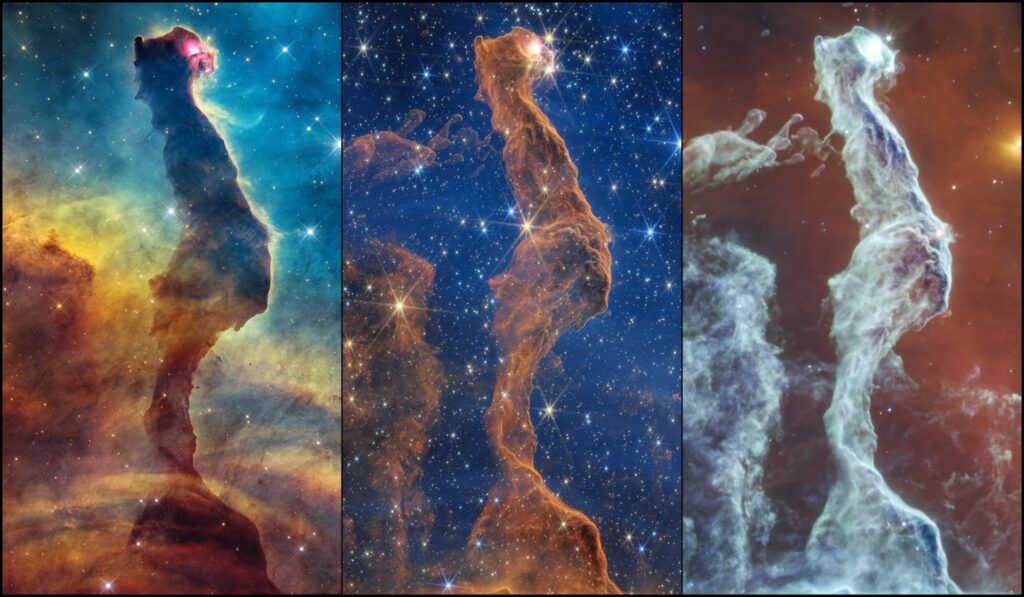
It isn’t a real cat, of course. It’s a tall, twisting pillar of cosmic dust inside the Carina Nebula, about 7,500 light-years from Earth. But it really does look like a cat sitting with its back to us, head turned to one side, with one bright, glowing eye. Astronomers have nicknamed it the Cat’s Head Nebula.
On October 29, 2026, NASA and the European Space Agency released new views of it from the Hubble Space Telescope and the James Webb Space Telescope. Each telescope sees it in a different kind of light, and together they show something far more wonderful than a spooky shape: a place where new stars are being born.
Where this cat lives
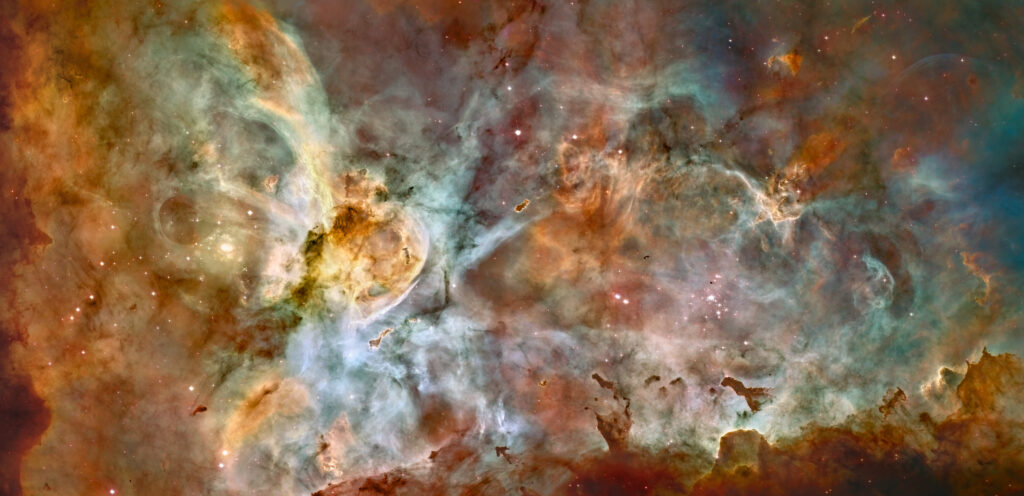
The Carina Nebula is one of the biggest and brightest star-forming clouds in our part of the Milky Way. It sits in the southern constellation Carina, the Keel, named after the ship Argo from the Greek myth of Jason and the Argonauts. From the Southern Hemisphere and the tropics, it can be seen with the naked eye under dark skies.
It’s also a rough neighborhood. According to ESA/Hubble, the nebula holds a dozen or more brilliant stars estimated to be at least 50 to 100 times the mass of our Sun. The most famous is Eta Carinae, an unstable giant that astronomers expect to eventually explode as a supernova.
Those monster stars pour out fierce ultraviolet light and powerful stellar winds. Over time, that energy eats away at the clouds of gas and dust around them, carving the nebula into cliffs, pillars, and odd shapes. The Cat’s Head is one of those shapes.
Why it looks like a cat
According to the ESA/Webb release, the cat’s shape was likely sculpted by the ultraviolet radiation and winds from those massive neighboring stars. As this “stellar feedback” wears down the surrounding gas and dust, the denser material inside the pillar resists erosion, at least for now.
Think of it like a sandcastle on a windy beach. The loose sand blows away first. The firmly packed parts last longer and end up standing alone, in whatever odd shape they happen to have.
The scientists are careful to point out that this is a temporary scene. Over time, as stars form and evolve, the Cat’s Head will be dispersed. We just happen to be looking during the cat’s moment.
Hubble’s view: a dark silhouette with a glowing eye
Hubble, which has been orbiting Earth since 1990, sees mostly visible light, the same kind our eyes see. In its image, taken with the Wide Field Camera 3, the cat is an opaque, dark brown pillar of dust standing against a colorful glowing background.
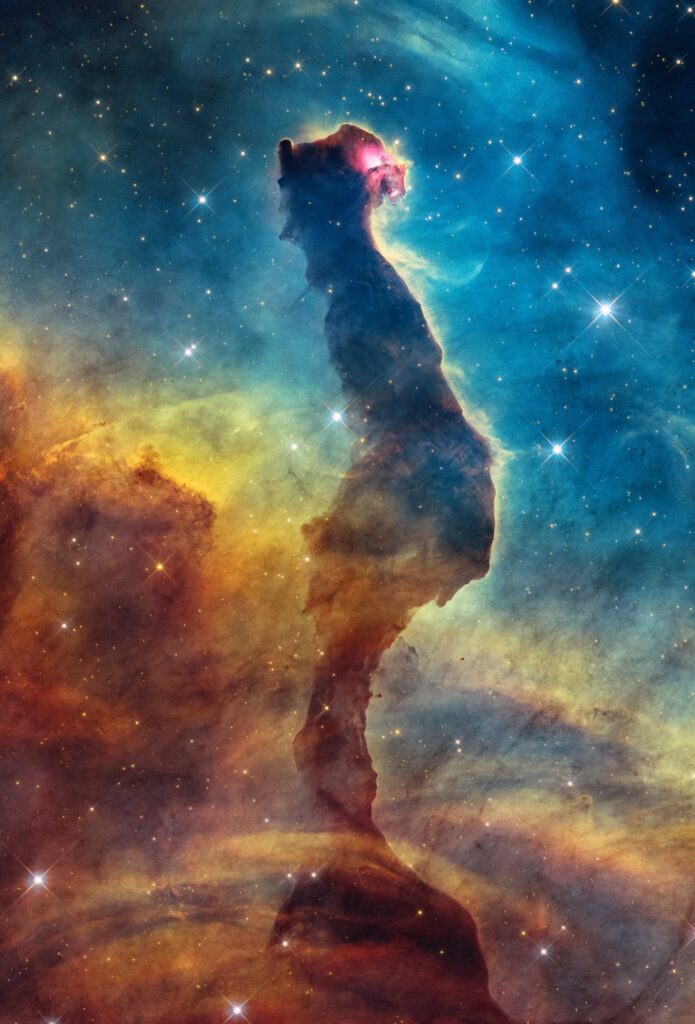
Near the top, the cat’s eye glows red. According to the release, this may be a young star that is still partly buried in the dust it formed from.
Along the cat’s right edge runs a hazy yellow ridge. That bright rim is gas being heated and ionized by ultraviolet light from nearby massive stars. In effect, the edge of the pillar is slowly evaporating, a process called photoevaporation.
The background colors tell a story too. The gas glows blue and cyan near the top and shifts to yellow, orange, and red toward the bottom. Hubble’s filters pick up light from oxygen, hydrogen, and sulfur, along with starlight bouncing off dust.
Webb’s near-infrared view: seeing through the dust
Webb, launched on Christmas Day 2021, sees infrared light, which has longer wavelengths than our eyes can detect. Infrared light passes through dust much more easily than visible light, so Webb can see inside places that look solid and dark to Hubble.
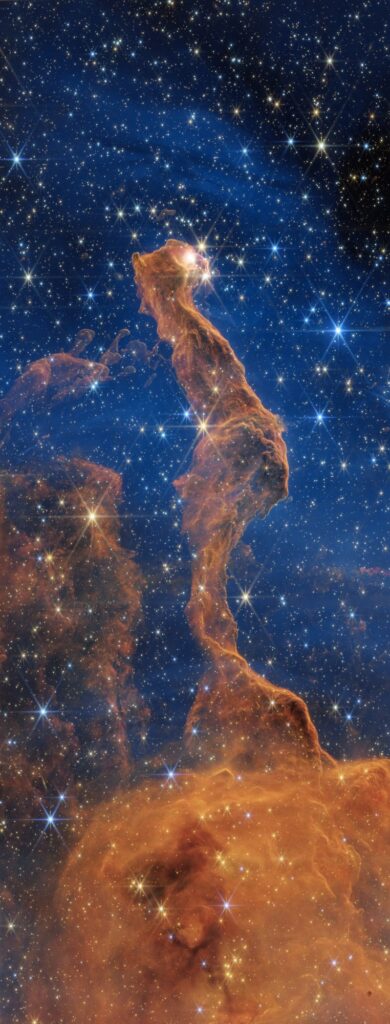
In Webb’s near-infrared image, the pillar becomes more transparent, and its complex, rippled surface comes into view. The sky around it fills with stars, shown in blue and yellow. Some of them are still wrapped in dust to varying degrees.
To the cat’s left, Webb picks out ghostly wisps of gas and dust being battered by radiation from nearby stars. And the cat’s eye is still there, glowing clearly.
Webb’s sharp vision even reveals faint galaxies far in the background. That means we’re looking through a dust cloud inside our own galaxy and out into the wider universe beyond it.
Webb’s mid-infrared view: warm dust lights up
Webb’s second camera, MIRI, sees even longer infrared wavelengths. At these wavelengths, the pillar doesn’t block light so much as give it off. Warm dust and carbon-based molecules glow, outlining the cat’s delicate inner structure.
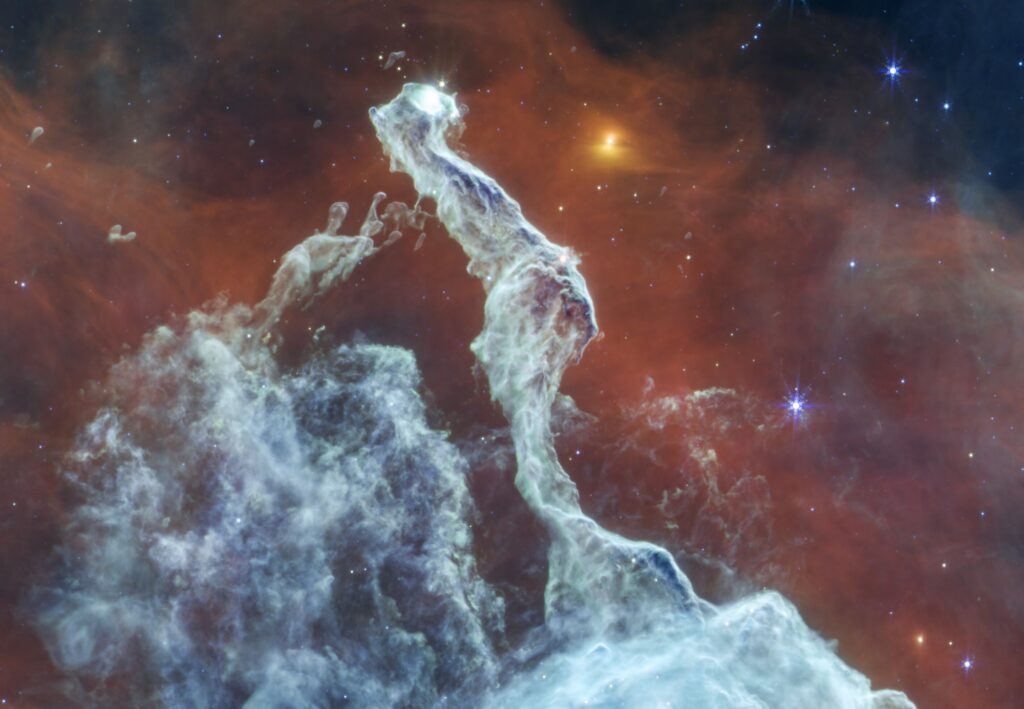
In this view, small globules and strands to the left of the pillar stand out especially well. To the cat’s right, a bright yellow source shines out. The scientists say it is likely an infant star embedded in dust.
A narrow filament appears to cross in front of it. In a nice moment of scientific honesty, the release notes that the image alone can’t tell us whether the two are actually connected.
Why this is more than a pretty Halloween picture
Star birth is one of the hardest things in astronomy to watch. It happens deep inside cold, dusty clouds, and it unfolds over millions of years. No single telescope or single color of light tells the whole story.
That’s why this pairing matters. Hubble shows where the dust is thickest and where starlight is eating away at the pillar’s edges. Webb’s near-infrared camera looks through that dust to count the stars hiding inside and behind it. Its mid-infrared camera shows the warm dust and molecules themselves. Put together, the three views help astronomers understand how massive stars shape their surroundings, and how new stars keep forming in the clouds they leave behind.
There’s also something quietly hopeful in it. Hubble launched more than 36 years ago and is still producing new science. Webb took decades for thousands of engineers and scientists across the United States, Europe, and Canada to build. Today they work side by side, and sometimes what they find is simply a cat made of stardust, keeping watch with one bright eye.
Sources
- ESA/Webb: Ghostly Cat’s Head Nebula lurks within sight of Hubble and Webb (Oct. 29, 2026)
- ESA: Ghostly Cat’s Head Nebula lurks within sight of Hubble and Webb (Oct. 29, 2026)
- NASA: NASA’s James Webb Space Telescope Captures Eerie Cat’s Head (Oct. 30, 2026)
- NASA Science: Exploring the Cat’s Head Nebula (visualization)
- ESA/Hubble: Hubble’s 17th anniversary: extreme star birth in the Carina Nebula (Apr. 24, 2007)
Image credits
- Cat’s Head Nebula, Hubble WFC3 + Webb NIRCam + Webb MIRI collage: NASA & ESA / ESA/Webb, CC BY 4.0. Resized.
- Cat’s Head Nebula, Hubble WFC3 image: NASA, ESA, STScI; image processing: J. DePasquale (STScI), CC BY 4.0. Resized.
- Cat’s Head Nebula, Webb NIRCam image: NASA, ESA, CSA, STScI; image processing: J. DePasquale (STScI), CC BY 4.0. Resized.
- Cat’s Head Nebula, Webb MIRI image: NASA, ESA, CSA, STScI; image processing: J. DePasquale (STScI), CC BY 4.0. Resized.
- Carina Nebula Hubble mosaic: NASA, ESA, N. Smith (University of California, Berkeley), and the Hubble Heritage Team (STScI/AURA), CC BY 4.0. Resized.