On the evening of October 18, a spacecraft about the size of a small car pointed its camera at a faint smudge of light some 1,280 kilometers ahead. For months, its target had looked like a single dot. This time, the dot had split in two.
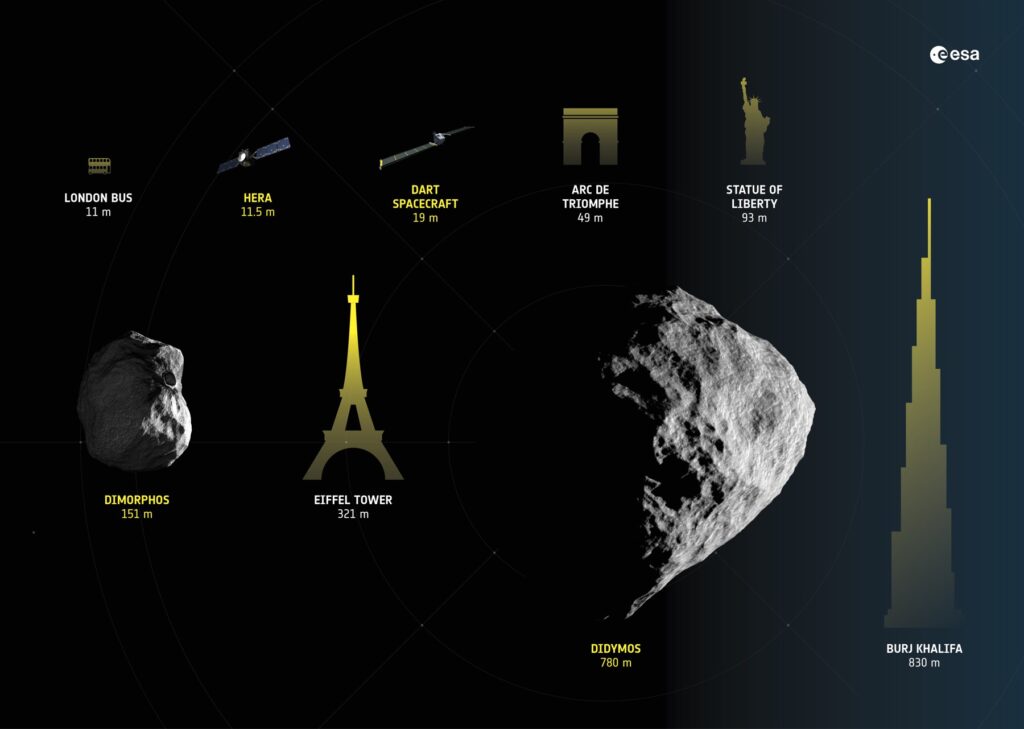
The European Space Agency’s Hera probe had just resolved, for the first time, the two asteroids it was built to visit: Didymos, a rubble mountain about 780 meters wide, and its little moon Dimorphos, just 151 meters across. In that first frame, Dimorphos takes up roughly a single pixel. But it is a very special pixel. Dimorphos is the first natural object in the Solar System whose orbit humans have measurably changed on purpose.
“With this image the smaller Dimorphos asteroid becomes visible for the first time,” Hera scientist Michael Kueppers said in ESA’s announcement. Mission manager Ian Carnelli put it more simply: “For the very first time we are seeing through Hera’s own eyes the very double asteroid system that the mission was designed and built for.”
The day humanity nudged an asteroid
To see why a one-pixel moon matters, rewind to September 26, 2022. That day, NASA’s DART spacecraft (the Double Asteroid Redirection Test) flew straight into Dimorphos at about 6.1 kilometers per second, roughly 22,000 kilometers per hour. Neither asteroid has ever been a danger to Earth. They were picked because they make a perfect test range: a small moon circling a bigger rock, so even a tiny change in its orbit can be timed from telescopes on the ground.
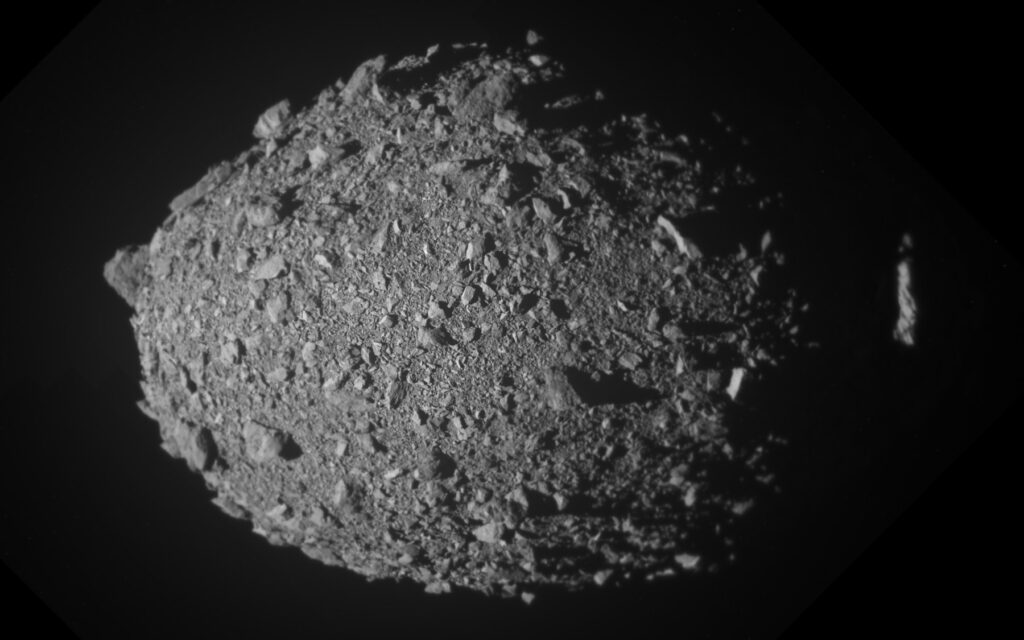
DART’s camera beamed back images right up to the end. The view below is built from its last ten full frames. It shows a lumpy pile of boulders, more like a loose heap of gravel than a solid rock.
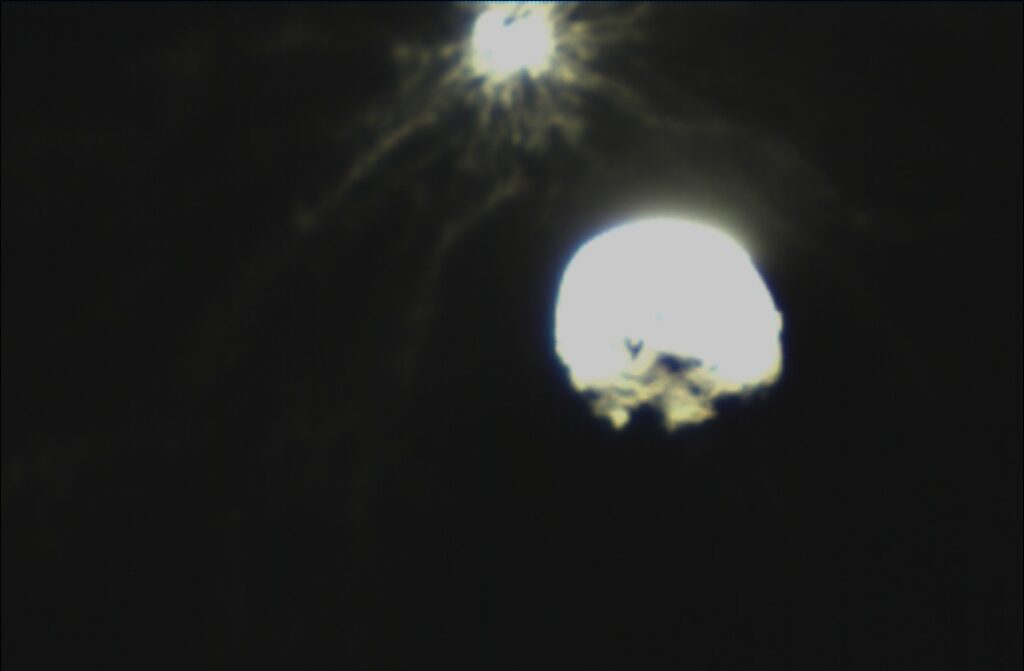
A shoebox-sized Italian cubesat called LICIACube, which had ridden along with DART and split off days earlier, flew past minutes after the crash and photographed a huge plume of debris shooting off the asteroid. According to ESA, that plume eventually spread across some 10,000 kilometers of space.
A bigger push than anyone expected
Then came the real test. Before the impact, Dimorphos took 11 hours and 55 minutes to circle Didymos. Afterward, telescopes on Earth measured about 11 hours and 23 minutes. That’s a change of roughly 32 minutes (ESA now rounds it to about 33). NASA had said a change of just 73 seconds would count as success.
It was the first time humans had deliberately changed how a natural object moves through space. And the nudge came out bigger than many impact simulations had predicted. Much of the extra push seems to have come from the rock and dust blasted off the asteroid, which shoved Dimorphos like a rocket exhaust.
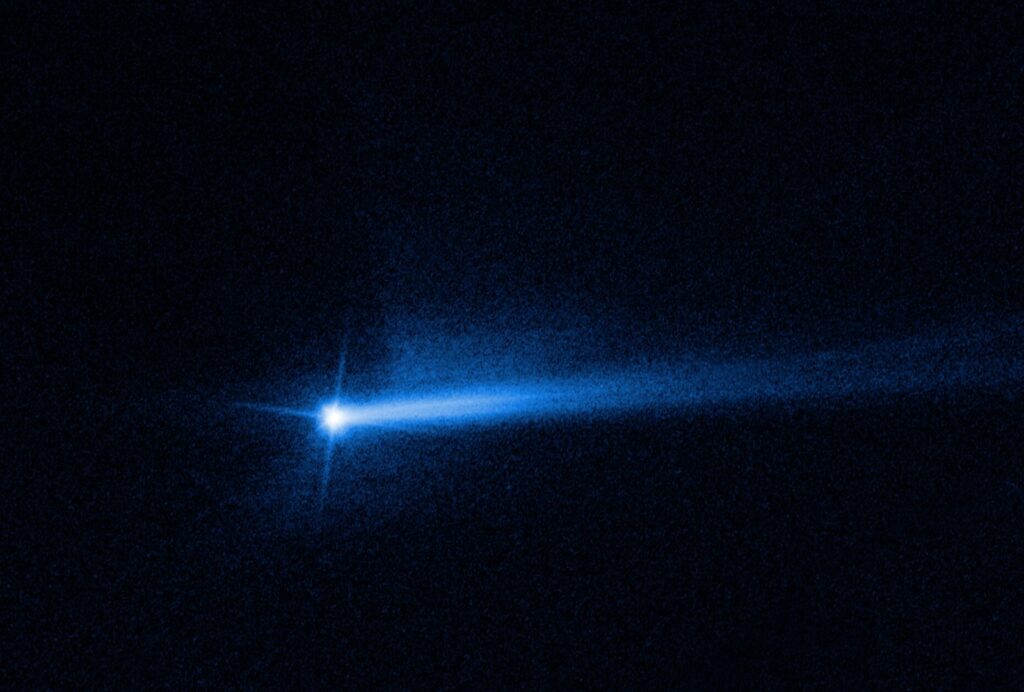
The Hubble Space Telescope kept watching. It saw the debris stretch into a comet-like tail, then a second one. Months later, it even spotted dozens of boulders drifting away from Dimorphos. They were probably shaken loose by the crash.
Why send a “crash scene investigator”?
Here’s the catch: everything we know about what DART did to Dimorphos came from DART’s final seconds, LICIACube’s quick flyby, and telescopes millions of kilometers away. Key questions are still open:
- Did DART leave a crater, or did it reshape the whole asteroid?
- What is Dimorphos made of inside, and how much does it actually weigh?
- Why did it move so much more than models predicted?
Those answers matter. If a dangerous asteroid is ever found heading our way, a “kinetic impactor” like DART is one of the few tools we’ve actually tested. To trust it, scientists need to know how a real asteroid responds to a hit. Hera’s job is to go back to the scene, measure everything, and turn one successful experiment into a technique people can repeat.
Two years, one Mars flyby, and some very careful braking
Hera launched on a SpaceX Falcon 9 from Cape Canaveral on October 7, 2024. In March 2025 it swung past Mars, using the planet’s gravity to bend its path toward Didymos, and snapped pictures of the Martian moon Deimos on the way.
This month came the delicate part. After two years of cruising, Hera had to slow down enough to meet two small, dark rocks instead of zooming past them. A 93-minute engine burn on October 15 and a 31-minute burn on October 22 cut its approach speed to about 20 meters per second. A few smaller trims are setting up its official arrival, which ESA has scheduled for November 4, 2026.
Don’t picture Hera settling into a neat orbit, though. Didymos’s gravity is so weak, tens of thousands of times weaker than Earth’s, that Hera will instead fly a series of slow, looping arcs past the pair, adjusting its course every few days. The asteroids are currently around 197 million kilometers from Earth, so every command takes about 11 minutes to arrive.
What happens next
ESA plans to reveal the first detailed images of Dimorphos on November 25, at a public event in Berlin’s natural history museum. After that, the mission steps closer in stages:
- Late 2026: Mapping both asteroids from about 20 to 30 kilometers away, including the first close look at DART’s impact site.
- Early 2027: Hera releases two shoebox-sized cubesats. Juventas carries a radar to peer inside Dimorphos, and Milani will study the dust and minerals. Both will try to land.
- Spring 2027: Hera itself creeps in, aiming to get within about a kilometer of Dimorphos before its main mission ends around June 2027.
Why this story is a hopeful one
Asteroid impacts have shaped Earth’s history, including the one linked to the end of the dinosaurs. For most of human history, there was nothing anyone could do about them. DART showed that we can move a space rock. Hera exists to make sure we understand how we did it, so the trick works next time if it ever really counts.
It is also a quiet triumph of teamwork: an American impactor, an Italian cubesat photographer, a European follow-up mission, and astronomers around the world all chipping in. That one bright pixel beside Didymos took years of planning to capture. In a few weeks, it should turn into a whole new world.
Sources
- ESA: First light, Hera resolves two asteroids instead of one (Oct. 27, 2026)
- The Planetary Society: Hera’s first view of both Didymos and Dimorphos (includes ESA’s first-light image)
- Orbinauts: Hera brakes a second time and is due to arrive on 4 November (Oct. 23, 2026; summarizes ESA’s mission timeline)
- NASA: DART mission overview (impact results and orbit change)
- ESA/Hubble: Twin tail revealed after the DART impact and Hubble sees boulders escaping from Dimorphos
Image credits
- Featured image and Dimorphos close-up: composite from DART’s final 10 full-frame DRACO images, NASA/Johns Hopkins APL, public domain, via Wikimedia Commons.
- Impact plume: ASI/NASA (LICIACube), public domain, released via NASA, via Wikimedia Commons.
- Hubble twin tail: NASA, ESA, Jian-Yang Li (PSI), Joe DePasquale (STScI), CC BY 4.0, via Wikimedia Commons.
- Size guide illustration: ESA – Science Office, CC BY-SA 3.0 IGO, via Wikimedia Commons.
- Hera’s own first-light image is not reproduced here because it is released under ESA’s standard (non-commercial) licence. You can view it at the ESA and Planetary Society links above.